Sunday, October 15, 2017

Disproving God, levels of atheism


Atheism is a funny thing, isn't it, trying to reason out and prove that God doesn't exist?  There's something strange about that project.  It's came up twice recently so I'll mention it here, really just to keep track of some interesting discussion. 

The first time was a Quora question answer, and the second related to a Facebook post about levels of atheism (or I guess agnosticism really is mid-level atheism, put on that sort of scale).

Quora answer


I answered the question on Quora, What's your proof that God doesn’t exist?:


With a background in philosophy and a good bit of formal study of religion I should put an answer to some form of this question here somewhere. I don’t think that’s the best way to frame such a question, but since I wasn’t looking for any version of the question I’ll just go with this one.

Of course it can’t be proven that God doesn’t exist. How can you prove that Santa Claus doesn’t actually exist? You can explain the origins of the story, and build a strong case for that tradition only relating to earlier forms of culture-based stories shifting to become that particular story, but checking satellite images to confirm that no one really lives at the North Pole is almost as good a counter-proof as that. Proving a negative is tough. Even in this case, when parents have a conspiracy going that involves none of the presents actually coming from some mythical entity, we buy them instead, all of them.

It’s more productive to look at what religions in general are really doing, and then map how Judaism and Christianity work onto that. It’s no small project. It works well enough as a counter-argument that if a minority of people are really Christian, and the literal take on Christianity is that all non-Christians go to hell, then that particular God is ok with most people going to hell. I guess as with really sorting through who might live at the North Pole that gets problematic. Maybe Santa really lives in Antarctica, and the stories got that wrong, and maybe that Jewish / Christian God isn’t splitting people into the heaven and hell-bound groups in that way (or maybe a majority really do go to hell, and then there’s purgatory, etc.). An argument from evil comes up too; why would such a God create this particular world, one in which someone could spend all day pointing out horrible aspects that people and other creatures experience, all sorts of death and suffering.

Again it works better to take a different approach, to dig deeper into what religion really is. To me—only my take—it doesn’t work well to use religions as explanations for first causes or afterlife destinations, even though those are two very common purposes for the story-lines. The conflict between the different versions is one obvious problem, but it’s sort of not about that. More mature takes accept that important patterns in societies are encoded in religions, in the teachings, rituals, social roles, and practices. One good example: if there was no form of morality at all in a society then it wouldn’t be orderly enough to be functional. Reasonably consistent social roles and practices wouldn’t stick; there wouldn’t be enough consistency in behavior and perspective to base laws on, or consistent economic practices, and so on.

It’s a good question if there could be a completely irreligious society, if the same types of principles could conceivably evolve without religion as an input. In one sense I don’t see why not, in another sense absolutely not. Let’s start with the latter, the negative version: people evolved into organized civilizations based on religious practices and religion-based worldviews over the past few thousand years, or at most 10 or 20 (most likely; maybe it’s a lot more complicated than that). There is really no way to initiate a reset that starts a civilization or society completely from scratch, to not build on some of that prior foundation. Here I’m claiming that at the least organized societies and religious principles evolved together, interwoven, although the claim in the sentence before this one was framed as stronger than that, with one underlying the other. Either way conjoining the two still seems to work.

Communist regimes have attempted this, to try and systematically eliminate religion, but even if those had been more successful in some sense they would still be drawing on the assumed structure and general perspective that came before, whether they wanted to acknowledge that or not. In the other more shallow sense why not; a society could retain some of the functional structure of common-ground understanding that evolved along with prior religions while at the same time shedding the literal forms of those beliefs. It wouldn’t be necessary to try to re-form a system of ethics—the underlying assumptions, the detailed principles, etc.—but people could do that, to describe the function, and then to say that’s still a necessary cultural element. Various forms of consequentialism are this type of thing, structures of ideas that say we “do the right thing” because it’s functional to follow those sorts of patterns, that people as a whole benefit from that.

Why would someone want to prove that God doesn’t exist? I guess one answer could be to get to the facts of the matter. Or if someone was concerned about that hell-afterlife possibility maybe a set of arguments could put their mind at ease. But it would be quite difficult to move past the types of general lines of thought that I’ve just described to eliminate the possibility of an entity that served as a first-cause as a possibility.

Some type of creator God could definitely exist. This is where atheists use a bit of slight of hand, it seems to me; they reject the forms of creator Gods that we’ve been proposing, waving away the most absurd aspects, and in the end rely on probability related to their take on a first take. It’s very unlikely that Santa Clause does actually exist, even though we can’t disprove that he does, and if we can flesh out a clear story for what religion is doing as we did with “Saint Nick” stories then we can sweep away the conclusion for existence of a literal God in a similar fashion. It just doesn’t work nearly as well in the case of religion. If there is a creator God we wouldn’t be able to relate to what that entity is like (unless “it” is as chatty as the Old Testament version, or happens to be some living person’s literal parent, then maybe so). So the idea is to reject something beyond our own comprehension instead, some broad category of possible things we couldn’t have much understanding of, which is going to be problematic for argument forms to dispel.

Levels of disbelief in God


A Facebook friend posted this scale of levels of atheism recently:


My initial response was this:

This whole scale seems to imply that one uniform interpretation of God somehow makes sense. If God has to be the chatty, opinionated, divisive Old Testament version or the slightly mellowed out New Testament Christian version he / she / it probably doesn't exist. If God is either some vague type of cause or origin for the universe involving intention or a possible underlying linkage between different forms of life then it's harder to judge.


Of course that didn't really work for the person who posted that; they wanted a number, and they interpreted the question framework as making sense.  To me this is why atheists seem to be talking past anyone interested in religion who is not really so concerned if the typical, literal, personal type of god exists.  Per my experience people who study religion move past that type of superficial take at the outset, and atheists tend to stick with it, and work around it.  Then they say "it doesn't matter," as if it really doesn't, all the while building up arguments and analysis that really use that form or something quite close to it as a crucial starting point.

I'm not sure that point ever became clear, and it's a bit of stretch to map out what religion is really doing in Facebook post comment, but I did answer further about how the question isn't well formed.

That online friend (or contact; however you use those concepts) explained that he thought the question made sense in this way:


While there are a multitude of different ways people follow faith and drastic differences in what those systems or beliefs may lead to in the actions and ethics of different people, this scale's utility lies in lumping all together based solely on what level of adherence one might have to their beliefs. Do you wobble or hesitate with what you believe in, or are you unflinching in your trust? It doesn't matter, in this specific instance, whether it is something innocuous like merely thinking there is some kind of connecting energy inside or between beings, or if it is thinking doing actions in life like feeding the homeless or blowing up nonbelievers will augment some sort of afterlife/reincarnation. In this instance they are all explicitly equivalent with thinking there are supernatural sentient beings that created everything or thinking drinking kale juice will make you lose weight or cure cancer. 

This scale doesn't distinguish between what you believe, what that entails, or what it might lead to in your actions throughout life - it just deals with what level you trust in those beliefs. If you think it more likely that what you "know" will stay the same, you are a lower number. If you are perfectly ambivalent, you are pure agnostic. If you think it is more likely that what you "know" will/can be overturned via empirical evidence, you are a higher number. 


Interesting; not bad as analysis goes, but this still doesn't seem to work.  I explain why I think that as follows:


To me this is asking for an answer to the wrong question. I get what you're saying; as framed it doesn't matter what the type of answer, it's really a question of degree. If someone says "I believe all things are connected in some way; I don't know the form," the question can apply to how strongly they believe that. It sort of doesn't work though, the # 2 relating to "I cannot know for certain but I think that "all things are connected in some way" is probable." This person isn't believing in any God, so per a different and more direct read they're really a #5 or 6. If you assume God or not God, or maybe God, you've already made all the interesting decisions prior to answering the question within the framing, and have already begged the question. 

To me this is like the problem in asking the question "what is the meaning of life" according to philosophy. It's kind of the wrong question, in the sense that there are much better questions to start on. One could ask what types of assumptions and context frameworks tend to support an implicit meaning of life. Generally that's too broad a question for either Analytic or Continental philosophy, but it works much better for the latter. In either broad-school context at least you are more directly asking what you are really asking, not skipping over it with assumptions.


Conclusions / analysis; what atheists are doing


I think we're narrowing in on the key problem with atheism and arguments related to atheism here; in one form or another they set up a straw man to reject, that very literal form of God.  It's not them that postulate that God initially, it's organized religion, in some forms of interpretation, but they do adopt it in the process of rejecting it.

They say they're doing the opposite, that their arguments work to reject any God, not just the relatively angry one in the Old Testament, or the ass-kicking version that some Muslims take up, or the more compassionate and vague version Jesus talks about (who of course is a bit paternal, in that form).  But really God has to be a super-person in those systems, in the form atheists tend to reject "him."  A bit of sleight of hand, as mentioned in that Quora answer, is involved in mixing between personal God and first-cause minimum level type of agency.  But this only makes the problems worse, rejecting a selected continuum, without really digging deeper into the function of religion.

If you don't think it through religion is all about solving the first-cause problem and the after-life problem, and deriving morality based on an appeal to authority.  I think the main function is much closer to the latter, but the draw, the personal appeal, is perhaps coming from that first set of two purposes.  This really would run long if I tried to explain what I think religion is doing, and it would be a personal take, there is no way that one person can explain a narrow range that's really it in a nutshell.  

But in a one paragraph version, I think religion codifies guidelines for how people should live in ways that support the development of an organized society.  It defines a system of morality that makes people working together in social roles possible, and helps define those social roles, to some extent.  Monogamy makes for a good example of both; identifying an institution of marriage, the concept of marital fidelity, and a stable family structure works as a basis for society.  That can even extend into non-traditional interpretation, eg. gay marriage, but problems can occur if a society doesn't gravitate towards defining family as some sort of valuable construct.  I'm not saying that a single parent can't possibly raise a child, and of course they can, instead that it's functional for there to be a norm that two people set up some form of contract towards the shared goal of raising children.  The project takes a lot of work even with two people on it, and the nearly two decade commitment time-frame is a bit extreme.  Other examples of the function of religious teaching relating to respect for personal property ownership or honesty also work.  It just gets complicated to flesh out how any one norm plays a clear role in grounding a society, and how real-life interpretation, codes of conduct, and exceptions tend to play out.

It might well seem that now I'm proposing some sort of interpretive slight of hand, that instead of discussing if there was an agent that caused the universe I've shifted to the function of teachings of a religion as the main point.  I would agree, that I just did that, except for not agreeing with the part that it's in error to do so.

Oddly a lot of the ideas I'm proposing are coming directly from a derivation of Christianity, from progressive religion interpretation from the second half of the 20th century.  Essentially within that tradition they were discussing how God as a super-person really didn't make sense, that this was a superficial form the ideas can take that has little relation to the actual function of a religion.  I suppose the earlier post here on Stages of Faith a bit earlier fills in more details on that.

As far as me answering that question goes, where I fall on the atheism scale, I suspect that all things are connected in an unusual way, at a deeper level than we can tend to experience.  Since that's not much of a personal God it doesn't work well to use that scale to reject or embrace one.  I suppose if you force that online contact's interpretation I hold that belief at the level of #3 (I cannon know for certain but I am inclined to believe that in some deeper sense things are connected), it just doesn't work as well to map that back onto a more literal theism / atheism.  

Thursday, September 28, 2017

Humor, and my kids' personalities before birth


Normally in any work related to Buddhism pre-birth personality aspects would relate to re-birth (reincarnation, for some), but I'm on the subject of how my kids seemed inside the womb instead.  It relates to two starting points:  telling someone about that in a message recently, and also a point raised by Jordan Peterson, that You-tuber psychology professor (really in this video about personality related to Piaget, but the next one related to Freud was probably slightly more interesting overall).


Jordan Peterson, my favorite psychologist (credit his website)


Let's start with those online discussion comments, the story about interacting with my kids before they were actually born:


I had believed that culture and learning through experiences must play a much larger role in personal development and attributes than genetics before I had kids, but that experience has changed that. My son and daughter were different people when they were still inside the womb; they could express it in the way they interacted while I would sing to them. Keoni was hyper in there; he would be excited to hear from me, and would really kick the side, and seemed to be agitated by being crowded towards the end when he was outgrowing the size of the space. Kalani interacted enough that I knew she understood we were communicating, in a sense, but she was calm about it. 

Even the way they both took being born matches up with the way their personalities turned out later. Keoni screamed like something horrible was going on, and stayed a bit hysterical for some time, and Kalani cried a little but then was curious to see what was going on. I can’t really fill in how that connects with how they are right now but it does. She first saw him when she was about an hour old, maybe just a little later, as we were coming down from the operating room level after she’d been cleaned up and checked out. She was in a plastic box to control temperature and access to air and pathogens, I guess it was, and as he looked at her and talked to her she smiled. I really didn’t think that’s an innate expression, and maybe it was just coincidence, but it really looked as if she recognized him. For sure she’d been hearing him for 9 months.


If I was more into psychology I'd probably be expressing that more related to big five personality characteristics, and could go on to say more about how it maps to how they are now, but I'm not that read up the subject.  Eventually I might do more with those concepts and models but the ordinary framing of related ideas probably covers a lot of the same ground in this case anyway.  I might add that to the extent that psychology and philosophy overlap (not so much, but a little) I'm a lot more familiar with it, since I did study that subject somewhat extensively.


I won't really say more about that part, about how they were as fetuses, or about how they seemed to already partly be who I would later know them as.  As an 8 year old my son is still easily agitated, and very emotional, and as a three year old my daughter is still a lot more calm and curious about new experiences, versus anxious about them.  He had trouble adjusting his first week of school, for example, or the first few weeks really, and she didn't, at all.  The ideas extend from there but most of the point is already made.

meeting for the first time, in a sense


Babies and sense of humor


Onto the second starting point already then:  Jordan Peterson raised the idea in that video about how babies seem to have a sense of humor almost immediately, or at least as soon as they are able to interact and demonstrate such an attribute.  He didn't explain it, and actually went the other way with that, mentioning it's not completely clear why they would possess that so early (or is it how?; maybe both questions make sense, and one comes before the other).  I guess it partly ties in with the idea I've proposed that a lot of someone's character is already pinned down before they are born, but here I'm going to take that mostly in a different direction.

I'll pass on some thoughts about why it would be practical to have a sense of humor so early.  Oddly I dreamt an answer to why.  It's kind of strange for my subconscious to be getting in on mulling the subject over, but why not.  It seems related to play.  He mentioned the importance and function of play before, which is all obvious enough, not exactly requiring psychological study to follow.  It prepares children to face real life situations similar to those they act out, and provides an opportunity to work on physical skills, and social roles, mapping related ideas together, exploring cause and effect, etc.

Related to parts of that, for young kids he mentioned "rough and tumble" play is critical, part of figuring out physical limits.  I'm reminded of my Dad throwing us into the air; the kind of thing kids love, and mothers don't like so much.  Of course I do the same with mine, with a favorite form as them doing a "super-baby" pose, holding them up overhead so they can experience that height and practice something like planking, sort of like a yoga move.  Apparently a baby can do that a bit before they are one year old, and my eight year old would still like to give it a go but kids get a bit heavy and unwieldy around 5 or 6  or so (he's 8 now).

Another type of play is to practice variations of simple games like peek-a-boo, which in Thai goes by "ja-ay" instead.  We most often play that with them older than one, in a form of hiding behind a curtain, but he refers to that as a game related to hiding simply by holding a hand in front of their eyes, so the kind of thing a baby a few months old could take up.  According to Jordan Peterson the game variations help them practice both reasoning and social interaction, related to recognizing more complex forms of patterns of the game (more or less; I summarize).

Why express humor within the first few months though, as early as they can possibly interact?  It makes one wonder what it connects to, and of course I have no idea, but I'll speculate.  It seems possible play and exploration are two related things, and so is humor.  If my kids see me bang my head it's funny to them, and although actually getting injured wouldn't be funny it seems to play a role in helping them avoid a more serious pattern of cause and effect.

Why would it need to be funny, though?  Games tend to be funny or at least fun, enjoyable, and this helps kids enjoy repeating the same type of practice over an over.  In an interesting observation Dr. Peterson mentioned that they are copying themselves in a lot of early learning, for example hitting a "mobile" with their hand, then trying to do it again on purpose, with it taking nearly countless attempts to master hand and eye dexterity.  There would have to be some reward mechanism to trying that sort of thing over and over; it couldn't really just be an academic curiosity to a baby in the same sense I might watch Youtube videos on psychology just to learn.  If it's funny to see something that doesn't match expectations in different ways, like a two month old banging a mobile around, or watching me bump my head, it might help with repeating the cycles of learning.  Actually hitting me on the head would work better as an example of physical limitations play, and they do get around to such things.

Linking the two ideas, about my son talking to me in the womb (communicating by kicking the side), and a baby playing with a mobile, there is no reason why the process would need to start at birth.  A baby would know where it's own hands were from idle months spent in the womb, with only itself and the edges as stimulus (and sound, and motion; they would hear and feel a lot from the outside world).

she could definitely smile within a couple of days


A baby enjoying the skill of banging into a mobile intentionally, or later sucking on toes, finding a new body part, and a fetus sucking it's thumb wouldn't seem to reflect the same emotional reward pattern as humor.  Even if they're related they still seem quite different.  It makes one consider what humor is really doing, and again we've reached a point where more background in psychology and awareness of common understanding would be useful.


Humor really spans a range, doesn't it?  Slapstick was based on enjoying people falling down, and fart jokes are kind of a lower end baseline,  seeing body functions that are regarded negatively as funny.  More intellectual humor is related to observation of unusual linked references, of getting a connection that is unexpected.  Related to function humor can diffuse a type of tension, or resolve a type of conflict.  Physical space and body control would pose a large conceptual problem for a baby for quite some time, so to them in a sense these could be lower forms of problems to work on, with situational tension and conflict requiring more concepts to build up to.


Considering a parallel with animals


It's a bit of a stretch but all of this makes me consider to what extent an animal can do some of the same things.  They tend to not really have much sense of humor, typically, don't they?  Or more intelligent dogs can seem to.  We had a cat that was painfully stupid (he would get stuck on the same roof for two weeks in a row, always forgetting how he got up there, or not realizing that he couldn't un-do those steps) and he seemed to really enjoy interactions and play on a level cats typically don't.  Of course "play" cats can do, and dogs, and it seems to fill a similar role.  A cat bats around a ball of string to mimic catching a mouse, although it's perhaps not clear that the same cause for doing both isn't common, that it could be acting out the same thing for them, not practicing one by way of the other.  Some dogs love to chase a stick as a game, and that does seem social, that it's as much about interaction as practice.  My brother had a cat he named "fetch" because it would do the same.  But what would a dog find funny?

If the same pattern holds they might expect something, and experience some degree of tension, or lack of expectation resolution, then something unexpected would happen.  Of course with my kids the unexpected thing can be the same hundreds of times; it's more just a resolution.  I would participate in rough and tumble play with the smartest dog that we ever owned; she would jump around, and pretend to bite me, barking a bit, and I would grab at her.  But it didn't seem to extend to humor, which would require more concepts.  Maybe a relationship to time and abstract concepts bridges play and humor, in ways that might not be obvious.

It's a given that dogs experience emotions, isn't it?  It seems so to me.  They experience equivalences to anger, and fear, happiness, anxiety, and boredom.  Cats less so; ours seem complex to me but not common with us in character, for the most part.  I raised pigs as a child (four; I wasn't exactly a farmer, but that was some experience) and they really do seem roughly as intelligent as dogs, but different in character.  Maybe they're less emotional.  Then again dogs learn to interact with us in the same ways we do based on different factors, which include how intelligent the dog is, other in-born character aspects, and the extent to which they interact with people, and related to the nature of that interaction.  This tangent really doesn't get far with the main theme since to me they definitely can play but humor is something else.  As far as I've noticed animals don't find things to be funny.

I Googled dogs and humor just to see if anyone thought differently, and it turns out Charles Darwin did (cited in this modern reference article on dogs and humor):


In the 1872 edition of The Descent of Man, he writes:  Dogs show what may be fairly called a sense of humor, as distinct from mere play; if a bit of stick or other such object be thrown to one, he will often carry it away for a short distance; and then squatting down with it on the ground close before him, will wait until his master comes quite close to take it away. The dog will then seize it and rush away in triumph, repeating the same maneuver, and evidently enjoying the practical joke.”


Play versus humor seem interrelated but different, as I've mentioned, but the article does go on to give dogs credit for extending into the latter.


Conclusion


I don't have much for conclusions.  My kids seemed to experience play to different degrees before they were born, or at least interaction, and I tried to extend that considering a relation to humor.  I'm not sure how early interactions with my kids seemed to clearly be expressions of humor, of finding things funny.  They seem quite aware long before they are able to make their own impressions of things clear, which builds up slowly.  If my daughter really did smile within an hour or so of being born then that form of expression is available nearly right away, or could be, but I'm not sure to what extent they practice and master such things versus learning them from scratch.


what she looks like now


Both my kids really did seem to know me within hours of being born, to recognize me by voice--but again that's a little off the main subject.  She might not have smiled within an hour but she did seem to use that expression in a typical way within the first week. 

I took a video of my daughter laughing for the first time--the kind of thing you would absolutely never catch on "tape" since you wouldn't expect it--and she was just over three months old then.  I guess in a limited sense she had already passed a milestone related to humor just then.  She wasn't laughing at something funny, really, unless her mother laughing with her seemed funny to her (and maybe it did).  Somehow I suspect me bumping my head would have been funny to her even before that, or her brother acting silly.  I guess the part about how or why she had that ability then I don't know, and can only ramble on about it in speculation, as I already did.


Monday, July 17, 2017

Conspiracy theories: a lie that you're tired of hearing

I recently answered a question on Quora titled "what is a lie that you are tired of hearing?"

I've been discussing conspiracy theories lately, and they're not exactly a lie (to some extent that's what they are though), so I wrote about that.  That topic and answers are listed here:

https://www.quora.com/What-is-a-lie-that-youre-tired-of-hearing


I just wrote a post about fluoride in tea in the main blog I write, Tea in the Ancient World (the one some people actually read).  I wasn't researching that related to any sort of conspiracy, instead about a question in a group about if the fluoride in tea poses any health risk.  I didn't know, so I researched it.
The short answer:  there is probably no risk.  Or maybe, depending on other factors, but this post isn't about that.  It's also not about the theory that adding fluoride to water could be part of a government mind control conspiracy.  I guess the idea is that it lowers IQ, making people easier to control, although in lots of discussion the general point is never really clear.

Since I've mentioned it I'll add a link to that fluoride post, and go on to the content of that answer:

http://teaintheancientworld.blogspot.com/2017/07/fluoride-in-tea-good-or-bad-how-much-is.html

Answer post:


It’s not exactly the same thing but conspiracy theories are getting under my skin a little lately. If it’s a conspiracy theory about something so clearly known that it’s absurd (eg. the earth is flat) then at some point that does clearly trace back to someone making something up, posting Youtube videos that propagate nonsense, so lying. If a climate scientist receives funding from oil or other fossil fuel interests and as a result concludes that climate change isn’t certain then that’s another case of lying. A poll just confirmed that most Americans don’t realize that 90% of all climate research scientists accept that it’s all proven (the basic understanding, that climate change is certainly occurring; the models will keep evolving), and that’s part of the background.

Beyond not keeping up with what is currently known people tend to want to believe in nonsense, it seems. They want nameless, faceless, powerful forces to be shaping reality in harmful ways based on lies, for whatever their reasons. At a guess it somehow seems nicer than believing the world just is as it is, a bit unfair, flawed in various ways, and that they aren’t personally more successful because of a stacked deck. Related to the theories everyday circumstances wouldn’t necessarily be tilted against the people that believe in those ideas, at least in ways that they can pin down—most of it isn’t about suppressing economic opportunities—but at least some other supposed examples of altered reality turn up that they can cite.


Examples:


-Fluoride added to water:  The current research evidence shows that fluoride is not harmful, in ordinary amounts, within a relatively clearly defined exposure range, and that it does protect teeth. But people want to believe that something else is going on, either a government mind control program or something else less clearly determined.


-The 9/11 terrorist attack:  this was clearly a case of terrorists using planes to destroy those buildings but people want to believe that somehow a separate conspiracy-related demolition activity occurred, or the US government was in on it. There is no clear reason why this has better explanatory value, and the supposed evidence put forward is usually easy to explain away as misunderstanding. One example cited is that the buildings fell downward, that they didn’t tip over, but falling straight downward is what is expected to happen if fires caused by plane impacts and burning jet fuel caused them to fall. People cite that steel doesn’t melt at the temperature at which jet fuel burns, and it doesn’t, but a guy in a youtube video shows how soft and flexible heated steel becomes at that temperature, so that it couldn’t continue to function as a building frame. The problem isn’t about one piece of evidence not holding up in any case, it’s about working backwards from a false conclusion, even fabricating evidence if necessary, but more usually twisting interpretations in strange ways.


-The moon landings: either that was by far the most comprehensive hoax ever pulled off (continuing to this day? so the Chinese really don’t have rovers on the moon now?) or else NASA really did send people to the moon, but it’s more interesting to some to believe that they didn’t. NASA just released a lot of photographs taken there to put an end to all of it but as with flat-earthers rejecting lots of real-time satellite feed images of the spherical earth it’s really not about analyzing evidence anyway.


At least in the case of climate change there is a good reason for people to hope that the world as we know it isn’t coming to an end, even if rejecting the current conventional understanding of reality is not a reasonable step to take. For the rest it’s more a preference for there to be a conspiracy, probably in lots of cases initiated by people that are either intentionally “trolling” (saying things just to get a reaction), or making money off Youtube video views and such.

Wednesday, February 1, 2017

Addiction and psychology, based on ideas from Jordan Peterson


A little background first:  I've been into watching Jordan Peterson's videos about psychology lately, based on an introduction from seeing an interview of him by Joe Rogan, a podcast host that covers a lot of different subject ranges.  His ideas are fascinating.  It's all quite developed work, a bit of a mixed bag, but nothing lightly grounded or swept together quickly.  All related parts are drawn from different sources over a long period of study, and not only from academic exposure.  From the Wikipedia post about him:


Jordan B. Peterson (born 1962) is a Canadian clinical psychologist and tenured professor of psychology at the University of Toronto.[1] His research interests include self-deception, mythology, religion, narrative, neuroscience, personality, deception, creativity, intelligence, and motivation.


This post is about a specific idea that's not at all at the core of his range of work and main projects, so I'll not really get into all that too much.  An introduction comes from citing what that scope covers further from that Wikipedia article:


Peterson’s primary goal was to figure out the reasons why individuals, not simply groups, engage in social conflict, and try to model the path individuals take that results in atrocities like the Holocaust or the Soviet Gulag. Peterson considers himself a pragmatist, and uses science and neuropsychology to examine and learn from the belief systems of the past and vice versa, but his theory is primarily phenomenological. Peterson explores the origins of evil, and also posits that an analysis of the world’s religious ideas might allow us to describe our essential morality and eventually develop a universal system of morality.


That's a fair representation, but his explanation of it and the course I'm following all drifts through layers of basics about how people work (mind, the brain, immediate experience, perception, etc.) that end up being more interesting to me than the conclusions, although that's good stuff too.  The more developed work on how mythology and religious symbolism works is quite informative, and it's not what you'd expect.  I've studied religion in university courses and it's not what I had expected, but it just goes further than what I've encountered, it doesn't contradict it.  I certainly can't summarize all that, but I feel compelled to say something, having brought it up.


A short, mostly incorrect version, too limited to be of a lot of use:  religion isn't doing exactly what it seems to be doing.  It's an afterlife scheme and all that, and an explanation of first causes, but on a deeper level the story lines embed in our view of reality, help shape it.  At first one would think that means we are accepting systems of morality based on religion, that we still draw on those systems' take on good and evil, and there's that, it's true, but it's not what I mean by that.  We pattern our response patterns, our underlying scheme for what we are and how we interact, on paradigms drawn from religion.

Sounds like something from Jung, doesn't it, that archetype business?  It is that, but fleshed out, in a way it goes way beyond capturing images we draw on--father figures, etc., with lots of layers of complexity beyond that-- to explaining how it actually works in practice.  To some extent, at least; there couldn't really be a full explanation, it's all complicated.  Since the point here isn't to treat any of all that I'll move on.

The topic here, about the addiction process


The point here, this following idea, is what I'm going to treat as an isolated fragment, although it is really more embedded in other ideas than I can fill out.  It still works excerpted, I think, or else this will be meaningless if I'm mistaken on that point.  The ideas come from one citation, as follows.


A class lecture from a Maps of Meaning course by Jordan Peterson (a video of one class session) starts into what goes on to enable substance addiction, with some background around 22 minutes in this video, with more on the specific subject from 23:40 up to 30 minutes or so, with the most detailed internal addiction process starting at 27 minutes.

Before going into more background I might also mention that Dr. Peterson is a clinical psychologist, a therapist of sorts, so his ideas are based on having a foot in two different realms, related to the theory and also practice.  It's not an idea or context that comes up here but it's a relevant point.


Jordan Peterson interview (credit and video here)


Starting point:  relation to the general project, what is being explained


At the risk of getting it wrong I'll summarize what he's saying, expanding a bit on the rest of what he's explained prior.  I won't cover in full detail what he says in that 8 minutes, so it might work best to watch that first.  It's part of a larger framework of ideas (a very large one) that he's explaining in the course, in general about meaning.  He builds up what meaning is "made of" starting from how mind and consciousness works, and he's more or less covering part of the latter here.  Getting to the bottom of either of those is too much for any one class, and to some extent human knowledge as a whole doesn't achieve that at this point.  To address that, and still draw on a broad range of ideas, he discusses ideas within a broad scope to map out a path from some basic parts up to what worldviews and related component frameworks are doing.

He's more or less explaining how internal psychological functions work, at this point, explaining meaning as the end goal.  To get there he goes through a lot of basic psychology, related to drives (not exactly how he frames that part, that's essentially a core component of an earlier model he's not relying on), and brain function (more on that in the next video, after the one cited), and on the higher level how meaning systems like religion and ideology work out.

It's particularly interesting how nihilism compares to those last two, with the three covering a similar function in different ways.  It's just a basic definition, but nihilism is embracing the idea that one's own world and experience don't have much inherent meaning (or none, but even stopping at "not much" starts into some contradictions).  Unless I'm characterizing it wrong he presents different alternatives for locating meaning, to reject it altogether, which doesn't work, to base it in an ideology or developed external system, which he says doesn't work, or to frame it in a more normal way, embedded in somewhat received formats as a unique personal project framework, or maybe more as a running underlying theme.  That last part really deserves more complete explanation and investigation than this mention provides.

He never does go into how to resolve the problem of addiction here, only talking through how it gets initiated.  The short version is that people build up dependency by positively associating with trying and continuing to use a drug (or alcohol, which of course is a drug).  It sounds so simple put that way; people try a drug and like it.  It's not quite that simple.

Addiction, related to the basic model and reinforcement of any routine activities


Again the citation reference, what I'm talking about here:  a class lecture from a Maps of Meaning course by Jordan Peterson on what goes on to enable substance addiction, with some background around 22 minutes in this video, with more on the specific subject from 23:40 up to 30 minutes or so.


He's explaining about addiction, the process of trying a substance or drug and how that leads on to addiction.  In particular how "liking it" (whatever the substance is) gets reinforced as a validation of whatever led to using that drug, or whatever is associated, so that over time more common-sense perspective related to negative factors and associations tend to be rejected.  He doesn't follow the ideas to a further conclusion, to exactly where this leads to a breakdown, and what forms that would be likely to take, but of course a lot of reasonable perspective could and would eventually be rejected.  Something like going to jail might come up, or losing a lot of whatever else a person had going on in their life.

It's not so simple to explain the whole model, or to break out just the piece about addiction.  In part it's not going to work really well to extract and deal with one relatively narrow idea--8 minutes worth of a 20-some hour video series--but that's the plan.

Instead of talking directly about the models of how we work (layers of them), a specific example works as an intro.  He discusses what happens when we get a drink of water (again I'm not going to find that in this video series, but watching a few hours worth of video would, and I think it might come in the next one).  A primitive part of the brain triggers the impulse to drink water based on monitoring hydration levels, a completely subconscious activity.  In his description that occurs in our mind as an impulse, perhaps of an image of use drinking water, visually, but in some form of awareness of the desire to get a drink.  As he describes it this is initiation of a micro-personality, of an internal sub-routine that conducts the related reactions, getting a drink.

We tend to not use the concept of "personality" in this way, but it makes sense.  It's not a simple conditioned response, but instead a response set of behaviors that involves a trigger, a perspective context, intentions, response action approaches, and reactions to hindrances to pursuit.

So we can dispense with drives, as an independent set of internal competing goals, since there is a whole layer of decision making going on below the one we are aware of.  Individual goals get activated, in whatever ways they do (here it works to just put that out of scope) and what we might think of as a sub-routine takes over, just a complicated version of one.

As we keep having experiences, making choices, pursuing goals on different levels, and having related successes and failures an interesting thing happens.  Minor set-backs are not exactly irrelevant but not so important within the system.  Significant interruptions or major setbacks play a special role, in that when these occur we have to then question if we are making decisions and taking actions appropriately, or question if our model of the world, our goals and basis for evaluation, are inherently flawed.  He calls these "anomalies."  I'll put all that aside for now, and move on to the role of more positive feedback.

One related running theme is that we are basically designed to ignore most of what goes on around us, that filtering helps us identify what requires our focus.  That really works on more than one level, related to immediate perception, and for the most part of course we really don't need to know how we work.  One simple idea is all we really need for getting part of this model:  positive outcomes--getting what we want--reinforce both the immediate causes of the decisions that just led to what caused those, and to the larger system in general, and of course those lead to repetition of the whole cycle.

There is more I might say about normal experience / sensation filtering, related to how it might be possible to turn it off, and what that experience would be like, but this has too many tangents and asides in it now.  The short version:  that wouldn't work out, at all, and normal experience would break down to an unmanageable, chaotic mess if we even briefly tried to interrupt that process, for example, through use of drugs.

Quitting, special problems related to that


Dr. Peterson touches on the idea of how this reinforces associations with other things or activities, which can lead directly to taking up drug use again after initially moving clear of it through rehabilitation.  All that is familiar even to a cigarette smoker, how everyday activities like waking up, going to sleep, eating, driving, and stress reactions become connected to smoking, so that even a few weeks or months past quitting these still tend to trigger a craving.

At the highest level this doesn't sound like much that's new.  It's a common idea that different types of associations are a problem related to addiction, more than a physical craving brought directly on by the drug addiction, the biological response.  It seems to me that doesn't seem to be interpreted beyond that activity-level association I just mentioned, and to personal relationships with friends that also use the same drugs (or alcohol, or it could apply to smoking, or I suppose the same general process could relate further beyond drug use, to other forms of habits and behaviors).

The novel part is how this gets coded (integrated) into a broad and deep set of associations that make up a world-view within his ideas.  Breaking those associations wouldn't be as easy as just learning new habits.  Even returning to an old set of associations, going back to a worldview and momentary behaviors that existed prior to taking up the drug use, might not really work well.

Per his other content, which I also won't cite here, stopping an associated behavior relates to coding a separate response that nullifies a conditioned response.  He speaks of the same process in terms of a sub-routine (a computer analogy) but perhaps more accurately related to his other characterization as associated with a micro-personality (tied to that earlier special use of that concept), just in this case more a mechanism related to offsetting that response cycle.  Clear?  It's not a critical point anyway, if not.

It's not so simple to map that onto how all that would play out with addiction, how patterns of behavior of using drugs would evolve, and where it might lead.  The behavior / association reinforcement process he described could lead to triggering an ongoing response mechanism that would barely ever stop, potentially.  It would amount to an unusual form of break-down of the normal impulse and reward system.

Anyone who has known an alcoholic has witnessed an example of that.  I worked with two people that couldn't take a break from getting drunk during working hours, and it wasn't ideal in either case.  One guy "held his liquor" really well, and the one woman didn't, but he was compelled to drink the equivalent of a half-dozen drinks during working hours, enough for the average person to become good and drunk.

Another friend took it much differently; he drank almost to the point of losing basic bodily functions if he touched alcohol.  It's not so easy to map onto these other ideas but that friend--a roommate in this case, and a really good guy--said that he felt somehow he really enjoyed or connected with achieving the goal of getting alcohol, of obtaining it, more than the part that came later, getting really, really drunk.  Another friend started drinking by noon every day, passing most of his life over to that experience.  Even if there were some common mechanisms and shared ground in their experiences it all played out differently.  It does seem like I knew a lot of people really into drinking, for whatever reasons, part of a longer story.

The alcoholic or drug addict's concerns might relate more to un-doing the process and associations than understanding how it all worked.  I don't have much depth of experience in that.  I would expect that re-writing their life might be a requirement.  One might naturally wonder to what extent going back to a former lifestyle (perspective and set of responses) would or would not be an option, typically.  At a guess since the addiction evolved along with changes in habits and perspective that may not work well, since little by little that previous framework (worldview, set of responses, perspective, etc., but really on the immediate response level most critically) had given way to a revised approach.  If it somehow related to participation in two completely different lifestyles, in two different social circles, or related to living in two different places, for example, then maybe it would tend to work better.

I did smoke cigarettes at one point and have experience in switching that habit over to just not doing it, which seemed to work better coupled with a physical move, to living in a different place.  It didn't help with completely cutting off the associations and craving but it seemed to work better that way.  It still took months for the stress-response trigger to wear off, or maybe around year for it to more completely dissipate.

Maybe it's more relevant talking about going back to school (university studies), related to how that mapped back onto restoring an earlier lifestyle and perspective, and to what extent it didn't.  I mean this in relation to the idea that an addict might simply go back to seeing things as they had before, to that set of responses.  I did so in my 30's, so it was quite a break from a different lifestyle, and well removed from my first experience from the age of 17 to 21.  In some broad senses I did restore my life to a student's experience but it was far different from the first set of experiences.  I could never really just be that person again.  I was older, and it was a different place, different schools (two, really), and relationships and connections were different.  It's hard to map that back onto how an alcoholic, for example, might restore a more limited set of responses from not drinking, to drinking, then back to not drinking.

The more general point is that we experience ourselves through those types of immediate associations, almost as them, in a sense, and the coding and uncoding isn't so simple.  I never really felt like a 22 year old student, although it did all fit back together in a sense, but I think it would be much harder project to change only one set of responses within that same set of conditions.  It wouldn't be the same type of thing.

I've really walked off the map quite a bit, since the original idea was that immediate, conditioned response, so recovery and re-conditioning is a completely different point, and one I have no background to address.  I would expect the general range of recommended recovery planning would be to "make changes," and I probably shouldn't go beyond that here.  I only found this one point interesting, about how addiction develops, and although it was a bit messy trying to break out that idea along with limited background that was the idea.

Wednesday, December 21, 2016

The end of the American Dream


An article I ran across more or less pronounced the end of the American Dream (in the Wall Street Journal, here).  The issue:  "barely half of all 30 year olds in the US earn more than their parents did at a similar age."  Of course this isn't related to Buddhism, this is just a good place to keep some writing and research on this topic.

Let's check a graphic about that subject, from the article:


It looks bleak, doesn't it?  One of the things that struck me about the article is that they didn't pause to examine any assumptions.  Why is it part of the American Dream that people should always earn more than their parents, and isn't that eventually supposed to level off?  It's not as if a lot of those people were the Irish just off a boat fleeing a potato famine.  If their stats somehow missed capturing Mexican immigrants then immigration might not play so much of a role at all.  

People that are 30 right now were born in the mid-80's, and their parents were experiencing the tail end of the American economic superiority that came from being at the lead of globalization development after World War Two.  It's not surprising that most of that leveling off of standard of living improvements occurred by the 60s, although the Great Depression 30 years prior to then throws off clear expectations a little.

I'll back up and get to some assumptions soon enough but lets look at where they go after making this observation, after a claim it's even worse in the Midwest, partly related to the rust-belt issue:


If income distribution remains as tilted toward the wealthy as it is now, they calculate, it would take sustained growth of more than 6% a year, adjusted for inflation, to return to an era where nearly all children outearned their parents. Since World War II, the U.S. hasn’t experienced anything near that level of growth for a lengthy period of time.

Even growing at 3.8% annually—about what Donald Trump pledges to produce as president—would only increase the percentage of children able to outearn their parents to 62% from 51%. Many economists are skeptical that the U.S. can grow anywhere near that level and is more likely to grow at around 2% a year.


Lots of assumptions folded in; somehow economic growth is what we need.  There is no justification here for why that growth would have more people better off at all, or why those different numbers link up, and depending the form growth took none of those people in that bottom 50%--related to this indicator--may improve status.  A closer look at causes and income distribution, what had actually changed, might work better before prescribing a solution.

In discussing the article another friend chimed in with solutions as well, one who feels like he knows a good bit about lots of things, since he has an MBA:


It's supply and demand of labor. In the US, manufacturing, which has historically and still pays better wages for the workers with the least education, has fallen to under 9% of GDP, compared to China at 33% and Germany at 23% (from memory, but should be close). The supply of workers is going up, as we are creating more workers for fewer high paying jobs. The causes are hard to fight, but include currency manipulation by China and Japan, poor trade policy enforcement, high tax rate, elimination of protections, and better access to low wage workers that have better machinery than before. 

The US birth rate is high compared to the rest of the west, and we have more immigrants, legally and illegally. The bigger problem is that manufacturing is shrinking globally too, as automation has reduced the global manufacturing employment by half in 20 years, according to the world bank... The answer isn't pouring supplements and taxing income, it's investing in vocational education like the Germans do, turning off illegal immigration, fixing tax policy, and battling currency manipulators. Most of that is as popular as a root canal politically.


Some of that sounds right, some seems way off; most seems quite difficult to evaluate.  One aside:  China has roughly a billion more people in it than the US, and we can't say how their average standard of living is shifting without a closer review but they are regarded as the most dominant world economy now, in some senses passing the US (related to adjusted GDP).  But then manufacturing shifted to there in part because wages are much lower, so all that is surely complicated.  Before getting into all that lets look at one factor neither of those inputs is considering, the balance of wealth in the US now.

Balance of wealth as a related factor


This subject was mentioned in the article, but not discussed.  A starting point comes from this graphic from a popular news source (The Guardian):


That source describes the trend as such:

Over the past three decades, the share of household wealth owned by the top 0.1% has increased from 7% to 22%. For the bottom 90% of families, a combination of rising debt, the collapse of the value of their assets during the financial crisis, and stagnant real wages have led to the erosion of wealth.


That MBA-holding friend and I have discussed the difference between wealth (holding assets) and income (earning a revenue stream), and they are different things, but of course they do correlate to some degree.

In another discussion we ran through that difference, and the numbers review left off at concluding the top wealthiest 1% hold a third of all wealth in the US.  But then small differences in how data is presented can shift what seems to show up (like this graphic relating to families, not individuals, or discussing wealth versus income, etc.).  If the top .1% really do own something like 20% of all wealth and the next .9% only hold the next 15% there seems to be income inequality among the wealthiest too.


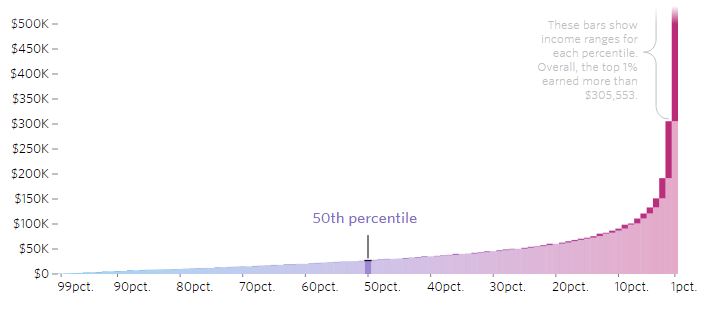
Here is a Wall Street Journal blog graphic addressing income instead, the other issue:


Completely sorting all that out is a post for another day, but it's clear enough that within that top 1% people are probably generally doing a lot better than their parents (350K US is a good wage, and that seems to just be the bottom threshold).  Within the bottom 50% it just depends on how poor their parents happened to be, but it's still the relatively opposite story.  30k doesn't go so far (the upper limit for that group), and the lowest quarter are getting by on between essentially none and way under 20k.

This American Dream article is talking about income related to parents only, averaging out everyone, so who fits where aside from that one benchmark gets lost in the original data.  It just doesn't go into that; people all across that spectrum of being wealthy or poor could be better or worse off than their parents were at 30.  We might assume the middle class is just not gaining ground, and the poor are staying poor (something like half of them, at least; half the people in that study were better off than their parents), so in general across a broad range people just aren't moving up in terms of income level.  Of course eventually one might expect improvement in standard of living to level off, it just doesn't seem like the author of that article thinks these are the right conditions for that to occur, all more implied in that content than expanded upon.

As I'm presenting it there really needs to be three different reviews, to see what's changing with the top 1%, then the next 10 or 20%, then related to the rest in the bottom.  Given the discussion is about in general, the 50-50 split across some doing better and some not, the 1% at the top almost isn't relevant; there is 99% more to consider.  Related to who holds the wealth of the country in general that small better-off group definitely are improving status; they own a third of all of it, give or take.  But the concern and marker here is average adjusted income related to their parents' generation instead, with the only relevant benchmark what a 30-year-old's parent's earned at 30.


looks ok, but different graph arrangements always imply different things (source)


Back to why (speculation)


That friend raised some points that seem right to me, about manufacturing and jobs types changing, but in general I wouldn't agree with most of those details.  I'm an industrial engineer, for what that's worth, and from the rust belt (PA), so the part about manufacturing moving away is familiar.  I saw it as a child, in the 70s, well before that education helped make sense of it.  It's odd to me that my friend says "we need to invest in vocational education," as if that's somehow going to bring back manufacturing or give service employees a better wage for what they're already doing.  It seems it wouldn't help, with either.  Germany retains manufacturing in their quite developed country for reasons that must be complex, and surely education is only one piece of the puzzle.


I don't think currency manipulation is a key part of the problem; it seems to instead tie back to other countries doing manufacturing, not us (the US).  Japan is almost surely in the same boat related to some of the US's problems, accounting for some of their difficulties, although I would be surprised if it all doesn't play out much differently there.  That initial Wall Street Journal article concluded on a point about the wealth distribution issue:


Revamping the tax code so that it taxes the wealthy far more heavily and gives bigger breaks to those in the middle class and below could also work, said Mr. Chetty, but he doesn’t advocate that strategy.  “It’s actually not clear to me that a more progressive tax code is necessarily the solution,” Mr. Chetty said. “Many think of the American Dream as ‘earning’ more than their parents, not getting more transfers from the government than their parents.”


I'd have to completely disagree with that framing.  Addressing the unequal distribution of wealth issues with a real progressive tax system is nothing like a wealth transfer, it's a taxation choice the country's government makes.  It is strange case to consider a very poor family living on better or worse social welfare handouts than their parents, who were also on social welfare, but for the most part that's not who the discussion is about.

Donald Trump makes for a good example; he pays no taxes, for the last 20 years, because tax laws allowed him to cite investor losses as his own losses, and he was also able to offset the personal impact (his liability) through bankruptcy protection.  He was worth a large negative amount not so long ago, but it wasn't a problem, laws protected him.  It's not as if that's the one exception, that the wealthiest in general are really propping up the government while their income and holdings are decimated, while the poorest three-fourths live on government hand-outs instead of paying into the systems.  The opposite is true in some senses; some of the taxation systems are regressive (sales tax, social security, etc.), with loopholes and shelters built in to offset a progressive tax rate, so the wealthiest do just fine.  In terms of proportion of wealth held and income they're doing really, really well over the past 30-40 years.

Of course taxation could only help so much, dropping back what people in the middle or bottom contribute.  The income side also needs to be addressed, and it's appropriate that the focus is there instead related to root causes.  To be clear, I think the main cause and problem lies with both, though.  In the comments section of the article people raised other issues that really do also seem relevant, like the cost of education going up much faster than inflation and income compensation.  If some of those 30 year olds evaluated as doing better--in terms of income--were crippled with 100K USD+ of student loan debt (and many surely were) they could be evaluated as "doing better" without feeling like they actually were, or without having the expendable income that should relate to that.

Even prior to that I was scattered among issues, right?  Is it really manufacturing leaving, the wealthy soaking up the country's wealth, or other policy and tax issues as a root cause, or could it be something like currency manipulation?  One factor is completely getting missed:  eventually wages were going to level out in the US, because as US manufacturing employees earn many times over those in other countries the centers for manufacturing and the jobs were naturally going to move.  That stopped being limited to people building cars awhile back; in the IT industry whatever could move over to India and elsewhere did a lot of moving over the last 20 years.  Now if you call someone for customer service help related to problems with your computer in the US you probably wouldn't be talking to someone in the US.  If someone in a foreign country could serve a morning coffee instead--via robotics?--that would be happening, but since they can't barista jobs are still safe.

One of the biggest problems is that the American people can't step back and see what the problem is, and leaders aren't really trying to either.  Trump claims he'll bring back manufacturing, which is more or less completely impossible.  NAFTA may have been a bad idea but undoing shifts in manufacturing inputs through protectionism definitely won't work.  Even if it did, the cost of goods would go up enough that the problem would just be shifted from one place to another.  It would take lots of extra taxes and other restrictions but maybe Americans really could build Iphones, they just might cost $1500 instead of $1000.  Maybe that's not the best example, since if someone could afford a $1000 phone then maybe they could also almost as easily afford a $1500 phone.

It's not as if Obama was working on that, or that Clinton was really going to try to sort it out either.  Simple protectionism, cutting off trade exchange through taxation, doesn't seem likely to work.  And it's also hard to see how any good can come from the mix of random policies and positions Trump seems poised to unleash, trying to burn down most of the social supports and other direction that US government has taken, destroying housing programs, banking regulations, and the educational system, etc.  Even ceasing climate change resolution doesn't seem so bright as a long-term solution.  Beyond potentially making the earth unlivable in another century it turns away from development in what really should be a huge growth industry, solving that problem, not just in the US but globally.  A trade war is a potential bigger problem, maybe closer to a cause of what is being regarded as a problem in that article.


GDP growth looks pretty good, except you when you consider how much is from debt (source)


My take on status and solutions


It's not as if I'd know, really, but I'll throw out some guesses.  To start, eventually US citizens will have to adapt to not continually earning and consuming more.  That one core premise is problematic, that it's necessary to do so.  In the comments some people raised the idea that in some senses people with the same purchasing power--adjusted income--as their parents could have higher expectations since there is more to buy now; people are carrying around $1000 phones, eating foods from around the world, taking part in gear intensive activities that weren't even invented yet back then, or at least not popular.

I think addressing wealth and income inequality will have to be part of the solution as well.  This part is the core of what sparked so much controversy surrounding Bernie Sanders, isn't it?  The old American myth is that people can strive to improve themselves and do better, and keep what they earn, and to some extent that's still just as true.  The balance of people keeping a lot more has been shifting over the last 40 years though, with 1% now keeping holding onto a third, and the bottom half pays a steep price for that.  Decimating social programs will make that price even steeper.

Bringing back manufacturing, shifting the balance of the economy to what it was 40 years ago, is most problematic.  I don't think it can be done.  My home area in rural PA is in terrible economic shape.  I wish it would be possible, I just don't relate to wishing for that by believing lies about the potential.

I see a main root cause being that the US government stopped focusing on the good of the people half a century ago.  Or maybe they never actually did, and things just worked out better by accident in the 50s and 60s, a temporary case, with clear initial decline occurring in the 70s.  Increased socialism probably is part of a complex answer to a very complex set of problems.  It may be a problem that we now contrast two different myths, that people can do better by working hard, and the US can take care of everyone through adequate social supports, like making education and health care affordable.
The US has a terrible track record related to offsetting free-market equilibrium for any issue but I think that relates to bad government more than to the invisible hand of the free market resisting supports.  Social programs in the US are designed to benefit special interests in addition to serving their original goal, because special interests control the government.

The end of the American empire?


“Rejoice with support from Allah, and find glad tidings in the imminent demise of America at the hands of Trump,” said the ISIL-affiliated al-Minbar Jihadi Media network, one of several jihadi forums to post commentaries on the results of the U.S. election.  (related source article)


All of this reminded me of a quote about a different subject:


Kind of the opposite of what I was just saying, wasn't it, since Nietzsche is rejecting socialism here.  A natural read of this is that exactly what Nietzsche was suggesting as a good thing, people trying out socialism and that failing, came to pass in the Soviet Union, and in a different story line and sense also in China.  The difference is that Russia reset differently, but in both cases the protections against the unequal distribution of wealth definitely ceased, and the planned economy aspects failed.

Of course socialism tends to refer to a few different things; one is the economic, planned economy system that caused the ideological-based political systems in the USSR and China to fail.  The other is the ideology that was behind those, really more what he is critiquing, or so it seems.

The back-story about capitalism--closely coupled with a free-market economic approach, which isn't really related to the rest--is about personal freedom, free speech, equality, etc.  Socialism stresses a different type of equality, an emphasis on protecting the common people from the unequal distribution of wealth other systems lead to, along with mixing in some other ideas.


Maybe it's also time for the US empire to end, for different reasons.  Maybe a demonstratio ad absurdum in the form of that empire falling is due.  It sounds like something the villain in Batman would advocate but that could just be where things stand.

Darth Trump: "In order to ensure our security and continuing stability, the Republic will be reorganized into the first American Empire" (credit)


US governments haven't been working towards the best interests of the people for some time, and electing Trump to correct that seems almost certain to make it worse.  The unequal distribution of wealth is worsening, and social protections to ensure some degree of basic equality are strained to the point of failing (health care, education, infrastructure and public transit, etc.).  Trade imbalance is another problem, not so closely tied to those.

My own take is that it hasn't worked to maintain a higher standard of living in the US than in the rest of the world, for lots of reasons.  A main one might essentially be that free market systems don't completely stop at one country's boundary, and the leveling up is unpleasant for Americans.  It's a really long story but protectionism is also problematic.  The US sinking to the level of being an average country, not a world economic or military leader, might resolve some of the problem, shifts in expectations occurring on different levels instead of restoring some flawed perception of a natural order.

I live in a developing country now, Thailand, but it's too much to go into how all that relates to here, how living standards relate, how shifts in this economy probably tie to shifts back in the US.  There are complex patterns.  It's funny how "real" issues like costs-adjusted income distribution and expectations combine together, here as in there.  I have no answers, just the observations I've already made.  I hope things go well for the US, although it's getting harder and harder to be optimistic, especially after the last five weeks.  Now it seems like avoiding catastrophe is the best possible outcome one might rationally expect, not improvement of any kind, and that half the population has intentionally rejected reason in favor of hopefulness.  Good luck with that.

Monday, November 14, 2016

Engaged Buddhism and crisis, related to the US election result


I wrote about why Trump might have won the election in the  last post, nothing at all to do with Buddhism, just reading up and passing on some theories.  It's funny that subject isn't dropping off.  More theories crop up about the role Facebook played (people see feed posts of only like-minded individuals, or even fake news), or blaming media sources for being biased (they were, just different sources for both candidates).

I was also just talking with a friend about the relation of Buddhism to this issue, about how non-attachment relates to potential stress.

His point:  we live in an imperfect world, and trying to experience it differently than it actually is isn't useful, or pleasant.  According to the teachings of Buddhism we need to live directly in the moment, which involves accepting things as they are.  So no freaking out, even if someone doesn't like the election result, or even in cases of real crisis.  I guess that could even extend to something like 9/11, so that a truly enlightened person might just think "we live in that kind of world now," but really how that reaction would work out sort of depends on interpretation.  Getting upset might be in order.

It sort of works, the extended "keep calm" take.  Sometimes it seems like freaking out is normal, maybe even for the best.  My grandmother died last year and I think it was healthy to be quite upset.  The King of Thailand died last month and this whole country was upset, and I think they should have been, that it may have been a healthier reaction than just saying "all things are impermanent" and moving on.  Buddhism has nothing to do with being emotionless, to me.  Of course that is just an interpretation, and I'm not claiming I've got it all figured out, that my take is just what the Buddha would have said.

This might be a good place to go a little deeper into what that friend was saying, which I'll quote:


The best thing is to not conceptualize your experience. Things are as they are. The interpretation that you conceptualize after the fact is totally subjective and not factual or even necessary. It is something to come to terms with, not the fact that Trump won or the King is dead. It is an indulgence of the world of ideas which have no basis in reality. Being in the here and now is the only antidote to this. 


It sort of works.  This sort of abstract take on things can also part ways with a practical, normal reality.  If I had no attachment to my grandmother then there wouldn't have been anything to be upset about, but I did, and that attachment was a good thing.  Now I'm mixing terms, since caring for my grandmother and the form of attachment Buddhist theory is talking about are almost certainly two different things.  The Buddha wasn't saying that people shouldn't love their grandmothers, and if he was then he was a jackass.  But I've spent a lot of time reading direct teachings from the Buddha, and interpretations, and it can all really make sense, and it's useful.  He was no jackass.

no need to let dying get you down, for some


It's hard to say if the Buddha transcended the normal experience of human emotion from the mix of old stories, if he would have seemed anything like us, or quite different.  It seems conceivable he was serene and transcendent in nature, but so much spin gets added to those stories that what is in them now hardly seems to be clear on that.  Teachings and descriptions say he did, essentially, that he was fundamentally quite different.  Per some stories he also did magic tricks and talked to deities, and in others he seemed to reject things like magic tricks and talking to deities (not completely unlike Christianity, although that is a different story).

I'll edit down my response a little, in which I embraced that line of thinking, discussing the normal experience of emotions to what might be a reasonable interpretation of applied Buddhist non-attachment.  The discussion was between three people, so the response might seem odd.  My ideas were positioned against two different kinds of response, that Zen-like-state version and another friend's more typical take, a bit shocked.  Then again, a Trump supporter wouldn't be shocked, but no need to go into that tangent here, all of this applies more generally than to someone just being upset about that one thing.


I get it about making peace with the result and our own reaction to the result.  Trump as President is the new reality, in January, and only limited forms of rejecting reality make sense (eg. taking actions that actually do change it).  At the same time grief is natural, and loss of a person and loss of an understanding of reality and a set of expectations aren't so separate, in this case.  

An emotional reaction is in order; this is human nature.  Moving to acceptance is a process, and negative emotions are part of the process.  Or potentially even moving through denial and anger phases, then onto depression and acceptance.

I cope through discussion, and a little writing.  For someone else they might just flip a switch, and say this is now, that other set of circumstances was then, and all is well.  Things are just as they must be, a mix of external events and whatever response we naturally take.  I've only lost the idea that Americans would have better judgment, not a reality where they actually did.  That was always only an expectation.  It's nice philosophizing about loss.  

Don't do anything crazy, although marching around and showing public disapproval seems harmless enough, if one felt inclined.  That really is feedback, likely not so functional, but it's a real thing.  I do the same online, move some ideas around a little.  I share the experience with friends and talk it through with others that don't share perspective as well.


It might seem like I'm taking it a bit personally, more as a tragedy than necessary, or compared to people I've talked to back in the States not so much at all.  I guess I see it as move back to the perspective of the 1950's, one in which men are better than women, whites are better than minorities, and religious tolerance and tolerance for people that see gender differently are non-issues; it's normal to be straight, and not really ok to be Muslim.  And I don't want to go back to that.  I don't want to be better than Mexicans for being white, I want all people to be created equally, like it says in the Constitution.  But all that is tangent.  We could almost as easily be discussing my reaction to 9/11 here instead, any change or event that's hard to accept.


he can't be that bad

Engaged Buddhism versus a less active take on Zen


There are two different takes on Buddhism that map onto two reaction patterns, which may not be familiar to everyone.  Zen would be, in general, one interpretation of which that friend is advocating.  It's all about equanimity, dispassionate acceptance, staying at the center.  How to take that related to immediate experience and what we should do or not do could go in different directions.  Here I'm sort of condensing it to mean inactivity, although it typically wouldn't be equivalent to doing nothing.  That friend isn't saying "do nothing," he's saying don't get upset, because the cause for being upset is only the way you position the ideas.

The story about the one founder spending nine years facing a wall indicates otherwise, that inactivity is just fine, or even great practice, but even that circumstance was probably not exactly like that.  Maybe that guy (Dogen) meditated part-time, and was socially engaged otherwise, although that's not how that story typically goes.  "Real" Zen may be more like a second pattern I'm going to discuss, about a way to be active, to not get away from emotion or doing things.

It's about Engaged Buddhism, a variation of Zen teachings taught by Thich Nhat Hanh.  Sound familiar?  He is a pretty big name, still with  us, but getting up there in years now.  To be clear, he is teaching Zen, part of that tradition himself, and there surely isn't a lot of discontinuity between what he is saying and some other very inactive-oriented form.  Zen is zen; a direct experience of reality, and people are just describing it differently, or different but related means to the same end.  Here is a website about his community and teachings.  Here are some related points from his 14 Precepts of Engaged Buddhism:


Do not avoid contact with suffering or close your eyes before suffering. Do not lose awareness of the existence of suffering in the life of the world...

Do not accumulate wealth while millions are hungry.... Do not maintain anger or hatred... 

Do not lose yourself in dispersion and in your surroundings. Practice mindful breathing to come back to what is happening in the present moment. Be in touch with what is wondrous, refreshing, and healing both inside and around you.... 

Do not utter words that can create discord and cause the community to break. Make every effort to reconcile and resolve all conflicts, however small.


Thich Nhat Hanh (photo credit)


So he is teaching others to be active, but to change perspective.  The same ideas about letting go of attachment are there, common to all types of Buddhism, just stripped of any directive to not experience certain kinds of things.  We suffer to learn not to suffer, to get to the root of what it is, then the form of experience can change so we aren't adding that to it.

One point in there is interesting, about not just avoiding staying inactive in meditation, but also about not losing your self-awareness to activity, described more clearly here:


Buddhism has to do with your daily life, with your suffering and with the suffering of the people around you. You have to learn how to help a wounded child while still practicing  mindful breathing. You should not allow yourself to get lost in action. Action should be meditation at the same time.

Interesting!  He's not really saying we should do a certain kind of activity, again more related to perspective in general, really in this all a "being in the moment" theme.  More about a specific crisis event helps clarify that:


John Malkin: When the World Trade Center was destroyed, you were asked what you would say to those responsible. You answered that you would listen compassionately and deeply to understand their suffering. Tell me about the practice of deep listening and how you think it helps in personal situations...


Thich Nhat Hanh: The practice of deep listening should be directed towards oneself first. If you don’t know how to listen to your own suffering, it will be difficult to listen to the suffering of another person or another group of people.

I have recommended that America listen to herself first, because there is a lot of suffering within her borders. There are so many people who believe they are victims of discrimination and injustice, and they have never been heard and understood...

If America succeeded in that, she could bring that practice to the international level. The fact is that people know America has the capacity to hit. To hit very hard and make people suffer. But if America does not hit, that brings her more respect and gives her more authority...

Violent action creates more violence. That’s why compassion is the only way to reduce violence. And compassion is not something soft. It takes a lot of courage.


So it would seem his advice is for people to understand why they feel as upset as they do about any changes, to make peace within themselves, and then apply the same process to others.

An interesting question:  would Thich Nhat Hanh still get angry?  On one read, no, he would be past that.  A philosophy and religion professor of mine once told a story of being at a function where Thich Nhat Hanh spoke, of being involved with the organizers and presenters, and conveyed how at one point someone in the crowd interrupting and asking questions that weren't relevant was throwing off the communication.  Thich (a bit much always writing all that) went in the back at one point to cool off a little, and expressed that the disruption was making him angry.  He was still human; he still experienced the normal range of emotions.  Some might say "he's not a real Buddha then" but I'm not sure he would claim to be one.  Emotions aren't a bad thing, but keeping a balanced perspective is still better for us.

Of course America isn't going to turn into a country full of millions of Buddhas.  This is intended as practical guidance, though, nothing abstract.  He thinks we can make peace within ourselves, and then make peace with people we would ordinarily consider our worst enemies.

It's odd thinking of a Trump supporter as an enemy in the same sense as a terrorist, but the dynamic is playing out that way this week.  Violence and hate is occurring on both sides.  Compassion and understanding won't work like flipping a switch but there is something to this, it's practical, or at least potentially so.

Of course we can't take "the other side" with us, completely.  If someone absolutely hates minorities and they don't want to change, or can't find influence to shift that perspective, then there is only so much that can be done.  Talking ISIS or Al Qaeda out of conducting terrorism seems a stretch.  But Thich Nhat Hanh is saying we can more or less break that cycle, bit by bit.  Or at least that's our best chance, not success through being the last one standing through successful application of violence.

Our President-elect isn't much of a Buddhist, but the rest of us can do better, and even he can.  A simple part of shifting perspective might just relate to giving him the benefit of the doubt.  When he says "illegal immigrants from Mexico are criminals and rapists" he is more or less expressing racist views, but it might be better to accept that as rhetoric aimed at coordinating shared views about concerns over the impact of illegal immigration with other Americans--his supporters--than jumping to the conclusion that we've elected a new version of Hitler.  The KKK supports Trump, and is happy he was successful, but that doesn't necessarily mean that he or his average supporter shares most of their views.  These teachings from Buddhism apply to trying to understand the most extreme opposing perspectives, to try to sort out the roots of views that seem clearly wrong by relating to them.

My friend's point was more about our own initial reactions, something much easier to control than to actually conduct peaceful relations with ISIS and white supremacists.  Our family is Buddhist--we live in Thailand--and although my own beliefs and background aren't so simple in terms of alignment I try to teach my kids to apply the most practical aspects, and then it's their mother's job to enforce the religious ritual aspects.  As I tell my son, if you can't control yourself then you don't stand much chance of controlling anything else.  Of course this isn't folk wisdom from my own tradition, in which righteous indignation is quite acceptable, it's from Buddhism.  On that subject, I'll add a little more about my own take on Buddhism related to everyday experience here.


looks cool, might be functional


Buddhism and everyday experience, some of my own thoughts


We just celebrated Loy Krathong here; that's sort of one set of practices related to Buddhism, holidays, rituals, and such.  That relates to floating a small bread or leaf and flower boat, lit with a candle along with incense, to carry off your sins.  I don't know the connection to Buddhism, but then Thais aren't always clear of those ties either.  I'm talking about something else, about immediate perception, not rituals.  About those boats, in addition to clearing off sins you also get to make a wish, kind of a common theme in Thai Buddhism.  No need to worry, America, I've got you covered; I burned my wish asking for that political / social mess there to clear up nicely.  Now hopefully it's not like the birthday one, where you can't tell anyone what it is or the magic doesn't work.


This subject naturally drifts into review of the related Pali terms, and parsing out roles of teachings and meditation, and separating mental faculties, etc.  I'll try to simplify beyond all that, of course limited to describing a very rough version of my own take.  Per the Buddha, we make life worse than it is, through mistakes in our take on perception and self, or even related to how we deal the past and future.  Accepting present reality as it is really is a lot of the message.  That doesn't mean dropping out our role in possibly changing it; our own activities and intentions are part of that present, as much as external factors are.  But we can't change the past of the future, and suffering over what happened or being stressed over what might don't really make sense; we only exist in this present.

Suffering is used in an odd way.  It's really a translation, and as with a lot of language translation the original range of senses doesn't match the translated version.  Even within one language, tradition and worldview a concept like "self" may not be pinned down as well as it initially seems, but when a concept is at the core of an unusual model of reality things really get unusual.  As I'm describing I see this as prescriptive as much as descriptive; it says how we can do better for perspective, just as much as it describes what people ordinarily do, mentally, in terms of context of perspective.

It matches everything my friend said, and what Thich Nhat Hanh is saying, it's just not as clear as it could be what those really mean.  According to a bad read my friend might be saying "just get stoned and let it all drop," and Thich Nhat Hanh might be saying "just try to be open and understand everything, and be compassionate, but not necessarily do anything."  Those aren't the point, although they may overlap with some of the ideas, and just miss the proper end point, the right view.

Suffering--in the one special sense--isn't being used as pain, or even mental anguish, but in a special sense.  It's about things being unsatisfactory for being different than they "should" be.  Everything really should be exactly as it is, in this present, because there is no changing the present, at all.  We can act, but then that's part of the present moment too.  To some extent sadness is still a reaction about a change that is natural, a carry-over from the past, but we can only part ways to a limited degree with normal human experience.  Maybe the Buddha had moved on, or maybe he didn't, but in a sense we don't need to worry so much about that.  If anger moves us to violence we have went way too far with embracing normal human nature, or if being upset takes us over, but to some extent reacting through emotions is fine.

Where is the right balance?  Hard to say.  It's potentially problematic to put ourselves on a scale of irrational / emotional up to Zen-line Buddha state, because we might just experience gap.  The idea is to improve over time, to personally benefit from a perspective shift, and to use that to help others.  Meditation is described as one tool for doing so, or the teachings are another, with mindfullness emphasized more than both in some traditions (conditioned momentary awareness).  So there is no magic bullet, along with there being no clear end state.

As with any subject someone claiming to be an expert is a bit of a red flag, although some others have varied experiences and perspectives.  I was ordained as a monk here in Thailand for two months once, and it's odd how that shifts things, someone being an authority based on wearing certain clothes, being in a formal role.  Lots of monks could be a lot more familiar with these basic ideas.  We learn from whoever or whatever is a good teacher, and someone in a formal teacher role might have the most potential, or they might not.


Really personal experience itself, our own momentary perspective, is the best grounds for learning.  In a limited sense it's the only basis for it; no one can pass on their perspective to you.  A teacher can lay out examples, or advise about practices, or explain teachings, even hit you with a stick if that somehow seems relevant, but everyone takes the steps for themselves, or else doesn't.  You either notice all this works and experience changes in perspective or you don't.


Unpleasant experiences can be quite useful, although again conventional suffering and our reaction to that suffering as a different kind of suffering are quite different.  Dissatisfaction with very uneventful experience could also be instructive, or maybe physical pain could be, or fear of the future.  Proper perspective of those would be critical, which typically wouldn't stem from just experiencing them, some guidance on how to take them would really make a difference.  Contemplation of death and impermanence as a means to learn is commonly referenced.  In a sense I'm really talking about un-learning, removing parts of ordinary experience that aren't useful, assumptions that relate to self and point of view.


And all that is kind of the simple version, as far as I might go without going on and on.  I like to discuss philosophy (and tea) so if I can help further with discussion I'd be happy to; just look me up.  Of course I'm no living example of these practices completely extended; I'm an ordinary person.  I feel all this works because following it to a limited extent seemed to help, and it has seemed accurate based on introspection.  It might be as well to close by noting this isn't really tied to any particular belief system, to reincarnation or making wishes, or separated from others, although lots of people would certainly take it that way.