An article I ran across more or less pronounced the end of the American Dream (in the Wall Street Journal, here). The issue: "barely half of all 30 year olds in the US earn more than their parents did at a similar age." Of course this isn't related to Buddhism, this is just a good place to keep some writing and research on this topic.
Let's check a graphic about that subject, from the article:

It looks bleak, doesn't it? One of the things that struck me about the article is that they didn't pause to examine any assumptions. Why is it part of the American Dream that people should always earn more than their parents, and isn't that eventually supposed to level off? It's not as if a lot of those people were the Irish just off a boat fleeing a potato famine. If their stats somehow missed capturing Mexican immigrants then immigration might not play so much of a role at all.
People that are 30 right now were born in the mid-80's, and their parents were experiencing the tail end of the American economic superiority that came from being at the lead of globalization development after World War Two. It's not surprising that most of that leveling off of standard of living improvements occurred by the 60s, although the Great Depression 30 years prior to then throws off clear expectations a little.
I'll back up and get to some assumptions soon enough but lets look at where they go after making this observation, after a claim it's even worse in the Midwest, partly related to the rust-belt issue:
Even growing at 3.8% annually—about what Donald Trump pledges to produce as president—would only increase the percentage of children able to outearn their parents to 62% from 51%. Many economists are skeptical that the U.S. can grow anywhere near that level and is more likely to grow at around 2% a year.
Lots of assumptions folded in; somehow economic growth is what we need. There is no justification here for why that growth would have more people better off at all, or why those different numbers link up, and depending the form growth took none of those people in that bottom 50%--related to this indicator--may improve status. A closer look at causes and income distribution, what had actually changed, might work better before prescribing a solution.
In discussing the article another friend chimed in with solutions as well, one who feels like he knows a good bit about lots of things, since he has an MBA:
It's supply and demand of labor. In the US, manufacturing, which has historically and still pays better wages for the workers with the least education, has fallen to under 9% of GDP, compared to China at 33% and Germany at 23% (from memory, but should be close). The supply of workers is going up, as we are creating more workers for fewer high paying jobs. The causes are hard to fight, but include currency manipulation by China and Japan, poor trade policy enforcement, high tax rate, elimination of protections, and better access to low wage workers that have better machinery than before.
The US birth rate is high compared to the rest of the west, and we have more immigrants, legally and illegally. The bigger problem is that manufacturing is shrinking globally too, as automation has reduced the global manufacturing employment by half in 20 years, according to the world bank... The answer isn't pouring supplements and taxing income, it's investing in vocational education like the Germans do, turning off illegal immigration, fixing tax policy, and battling currency manipulators. Most of that is as popular as a root canal politically.
Some of that sounds right, some seems way off; most seems quite difficult to evaluate. One aside: China has roughly a billion more people in it than the US, and we can't say how their average standard of living is shifting without a closer review but they are regarded as the most dominant world economy now, in some senses passing the US (related to adjusted GDP). But then manufacturing shifted to there in part because wages are much lower, so all that is surely complicated. Before getting into all that lets look at one factor neither of those inputs is considering, the balance of wealth in the US now.
Balance of wealth as a related factor
This subject was mentioned in the article, but not discussed. A starting point comes from this graphic from a popular news source (The Guardian):

That source describes the trend as such:
Over the past three decades, the share of household wealth owned by the top 0.1% has increased from 7% to 22%. For the bottom 90% of families, a combination of rising debt, the collapse of the value of their assets during the financial crisis, and stagnant real wages have led to the erosion of wealth.
That MBA-holding friend and I have discussed the difference between wealth (holding assets) and income (earning a revenue stream), and they are different things, but of course they do correlate to some degree.
In another discussion we ran through that difference, and the numbers review left off at concluding the top wealthiest 1% hold a third of all wealth in the US. But then small differences in how data is presented can shift what seems to show up (like this graphic relating to families, not individuals, or discussing wealth versus income, etc.). If the top .1% really do own something like 20% of all wealth and the next .9% only hold the next 15% there seems to be income inequality among the wealthiest too.
Here is a Wall Street Journal blog graphic addressing income instead, the other issue:
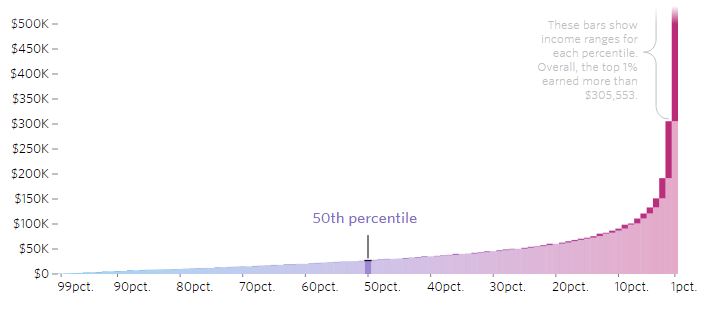
Completely sorting all that out is a post for another day, but it's clear enough that within that top 1% people are probably generally doing a lot better than their parents (350K US is a good wage, and that seems to just be the bottom threshold). Within the bottom 50% it just depends on how poor their parents happened to be, but it's still the relatively opposite story. 30k doesn't go so far (the upper limit for that group), and the lowest quarter are getting by on between essentially none and way under 20k.
This American Dream article is talking about income related to parents only, averaging out everyone, so who fits where aside from that one benchmark gets lost in the original data. It just doesn't go into that; people all across that spectrum of being wealthy or poor could be better or worse off than their parents were at 30. We might assume the middle class is just not gaining ground, and the poor are staying poor (something like half of them, at least; half the people in that study were better off than their parents), so in general across a broad range people just aren't moving up in terms of income level. Of course eventually one might expect improvement in standard of living to level off, it just doesn't seem like the author of that article thinks these are the right conditions for that to occur, all more implied in that content than expanded upon.
As I'm presenting it there really needs to be three different reviews, to see what's changing with the top 1%, then the next 10 or 20%, then related to the rest in the bottom. Given the discussion is about in general, the 50-50 split across some doing better and some not, the 1% at the top almost isn't relevant; there is 99% more to consider. Related to who holds the wealth of the country in general that small better-off group definitely are improving status; they own a third of all of it, give or take. But the concern and marker here is average adjusted income related to their parents' generation instead, with the only relevant benchmark what a 30-year-old's parent's earned at 30.
 |
looks ok, but different graph arrangements always imply different things (source) |
Back to why (speculation)
That friend raised some points that seem right to me, about manufacturing and jobs types changing, but in general I wouldn't agree with most of those details. I'm an industrial engineer, for what that's worth, and from the rust belt (PA), so the part about manufacturing moving away is familiar. I saw it as a child, in the 70s, well before that education helped make sense of it. It's odd to me that my friend says "we need to invest in vocational education," as if that's somehow going to bring back manufacturing or give service employees a better wage for what they're already doing. It seems it wouldn't help, with either. Germany retains manufacturing in their quite developed country for reasons that must be complex, and surely education is only one piece of the puzzle.
I don't think currency manipulation is a key part of the problem; it seems to instead tie back to other countries doing manufacturing, not us (the US). Japan is almost surely in the same boat related to some of the US's problems, accounting for some of their difficulties, although I would be surprised if it all doesn't play out much differently there. That initial Wall Street Journal article concluded on a point about the wealth distribution issue:
Revamping the tax code so that it taxes the wealthy far more heavily and gives bigger breaks to those in the middle class and below could also work, said Mr. Chetty, but he doesn’t advocate that strategy. “It’s actually not clear to me that a more progressive tax code is necessarily the solution,” Mr. Chetty said. “Many think of the American Dream as ‘earning’ more than their parents, not getting more transfers from the government than their parents.”
I'd have to completely disagree with that framing. Addressing the unequal distribution of wealth issues with a real progressive tax system is nothing like a wealth transfer, it's a taxation choice the country's government makes. It is strange case to consider a very poor family living on better or worse social welfare handouts than their parents, who were also on social welfare, but for the most part that's not who the discussion is about.
Donald Trump makes for a good example; he pays no taxes, for the last 20 years, because tax laws allowed him to cite investor losses as his own losses, and he was also able to offset the personal impact (his liability) through bankruptcy protection. He was worth a large negative amount not so long ago, but it wasn't a problem, laws protected him. It's not as if that's the one exception, that the wealthiest in general are really propping up the government while their income and holdings are decimated, while the poorest three-fourths live on government hand-outs instead of paying into the systems. The opposite is true in some senses; some of the taxation systems are regressive (sales tax, social security, etc.), with loopholes and shelters built in to offset a progressive tax rate, so the wealthiest do just fine. In terms of proportion of wealth held and income they're doing really, really well over the past 30-40 years.
Of course taxation could only help so much, dropping back what people in the middle or bottom contribute. The income side also needs to be addressed, and it's appropriate that the focus is there instead related to root causes. To be clear, I think the main cause and problem lies with both, though. In the comments section of the article people raised other issues that really do also seem relevant, like the cost of education going up much faster than inflation and income compensation. If some of those 30 year olds evaluated as doing better--in terms of income--were crippled with 100K USD+ of student loan debt (and many surely were) they could be evaluated as "doing better" without feeling like they actually were, or without having the expendable income that should relate to that.
Even prior to that I was scattered among issues, right? Is it really manufacturing leaving, the wealthy soaking up the country's wealth, or other policy and tax issues as a root cause, or could it be something like currency manipulation? One factor is completely getting missed: eventually wages were going to level out in the US, because as US manufacturing employees earn many times over those in other countries the centers for manufacturing and the jobs were naturally going to move. That stopped being limited to people building cars awhile back; in the IT industry whatever could move over to India and elsewhere did a lot of moving over the last 20 years. Now if you call someone for customer service help related to problems with your computer in the US you probably wouldn't be talking to someone in the US. If someone in a foreign country could serve a morning coffee instead--via robotics?--that would be happening, but since they can't barista jobs are still safe.
One of the biggest problems is that the American people can't step back and see what the problem is, and leaders aren't really trying to either. Trump claims he'll bring back manufacturing, which is more or less completely impossible. NAFTA may have been a bad idea but undoing shifts in manufacturing inputs through protectionism definitely won't work. Even if it did, the cost of goods would go up enough that the problem would just be shifted from one place to another. It would take lots of extra taxes and other restrictions but maybe Americans really could build Iphones, they just might cost $1500 instead of $1000. Maybe that's not the best example, since if someone could afford a $1000 phone then maybe they could also almost as easily afford a $1500 phone.
It's not as if Obama was working on that, or that Clinton was really going to try to sort it out either. Simple protectionism, cutting off trade exchange through taxation, doesn't seem likely to work. And it's also hard to see how any good can come from the mix of random policies and positions Trump seems poised to unleash, trying to burn down most of the social supports and other direction that US government has taken, destroying housing programs, banking regulations, and the educational system, etc. Even ceasing climate change resolution doesn't seem so bright as a long-term solution. Beyond potentially making the earth unlivable in another century it turns away from development in what really should be a huge growth industry, solving that problem, not just in the US but globally. A trade war is a potential bigger problem, maybe closer to a cause of what is being regarded as a problem in that article.
 |
GDP growth looks pretty good, except you when you consider how much is from debt (source) |
My take on status and solutions
I think addressing wealth and income inequality will have to be part of the solution as well. This part is the core of what sparked so much controversy surrounding Bernie Sanders, isn't it? The old American myth is that people can strive to improve themselves and do better, and keep what they earn, and to some extent that's still just as true. The balance of people keeping a lot more has been shifting over the last 40 years though, with 1% now keeping holding onto a third, and the bottom half pays a steep price for that. Decimating social programs will make that price even steeper.
Bringing back manufacturing, shifting the balance of the economy to what it was 40 years ago, is most problematic. I don't think it can be done. My home area in rural PA is in terrible economic shape. I wish it would be possible, I just don't relate to wishing for that by believing lies about the potential.
I see a main root cause being that the US government stopped focusing on the good of the people half a century ago. Or maybe they never actually did, and things just worked out better by accident in the 50s and 60s, a temporary case, with clear initial decline occurring in the 70s. Increased socialism probably is part of a complex answer to a very complex set of problems. It may be a problem that we now contrast two different myths, that people can do better by working hard, and the US can take care of everyone through adequate social supports, like making education and health care affordable.
The US has a terrible track record related to offsetting free-market equilibrium for any issue but I think that relates to bad government more than to the invisible hand of the free market resisting supports. Social programs in the US are designed to benefit special interests in addition to serving their original goal, because special interests control the government.
The end of the American empire?
“Rejoice with support from Allah, and find glad tidings in the imminent demise of America at the hands of Trump,” said the ISIL-affiliated al-Minbar Jihadi Media network, one of several jihadi forums to post commentaries on the results of the U.S. election. (related source article)
All of this reminded me of a quote about a different subject:

Kind of the opposite of what I was just saying, wasn't it, since Nietzsche is rejecting socialism here. A natural read of this is that exactly what Nietzsche was suggesting as a good thing, people trying out socialism and that failing, came to pass in the Soviet Union, and in a different story line and sense also in China. The difference is that Russia reset differently, but in both cases the protections against the unequal distribution of wealth definitely ceased, and the planned economy aspects failed.
Of course socialism tends to refer to a few different things; one is the economic, planned economy system that caused the ideological-based political systems in the USSR and China to fail. The other is the ideology that was behind those, really more what he is critiquing, or so it seems.
The back-story about capitalism--closely coupled with a free-market economic approach, which isn't really related to the rest--is about personal freedom, free speech, equality, etc. Socialism stresses a different type of equality, an emphasis on protecting the common people from the unequal distribution of wealth other systems lead to, along with mixing in some other ideas.
Maybe it's also time for the US empire to end, for different reasons. Maybe a demonstratio ad absurdum in the form of that empire falling is due. It sounds like something the villain in Batman would advocate but that could just be where things stand.
 |
Darth Trump: "In order to ensure our security and continuing stability, the Republic will be reorganized into the first American Empire" (credit) |
US governments haven't been working towards the best interests of the people for some time, and electing Trump to correct that seems almost certain to make it worse. The unequal distribution of wealth is worsening, and social protections to ensure some degree of basic equality are strained to the point of failing (health care, education, infrastructure and public transit, etc.). Trade imbalance is another problem, not so closely tied to those.
My own take is that it hasn't worked to maintain a higher standard of living in the US than in the rest of the world, for lots of reasons. A main one might essentially be that free market systems don't completely stop at one country's boundary, and the leveling up is unpleasant for Americans. It's a really long story but protectionism is also problematic. The US sinking to the level of being an average country, not a world economic or military leader, might resolve some of the problem, shifts in expectations occurring on different levels instead of restoring some flawed perception of a natural order.
I live in a developing country now, Thailand, but it's too much to go into how all that relates to here, how living standards relate, how shifts in this economy probably tie to shifts back in the US. There are complex patterns. It's funny how "real" issues like costs-adjusted income distribution and expectations combine together, here as in there. I have no answers, just the observations I've already made. I hope things go well for the US, although it's getting harder and harder to be optimistic, especially after the last five weeks. Now it seems like avoiding catastrophe is the best possible outcome one might rationally expect, not improvement of any kind, and that half the population has intentionally rejected reason in favor of hopefulness. Good luck with that.


